3D reconstruction using sparse algorithm and possion reconstruction
abstract
Video filtering
The first stage uses OpenCV. By reading the video frames and saving them at a reduced frame rate, OpenCV makes it possible to subsample and split a movie into numerous pictures. By cycling through the frames, you can save each image as a separate file in a designated location. Frame-by-frame analysis, image processing, and machine learning model training are just some of the many uses for the resulting image sequence that this technique makes possible. Subsampling a video and converting it into a sequence of images is a breeze with just a few lines of code thanks to OpenCV's robust range of functions and user-friendly API.
Sparse reconstruction.
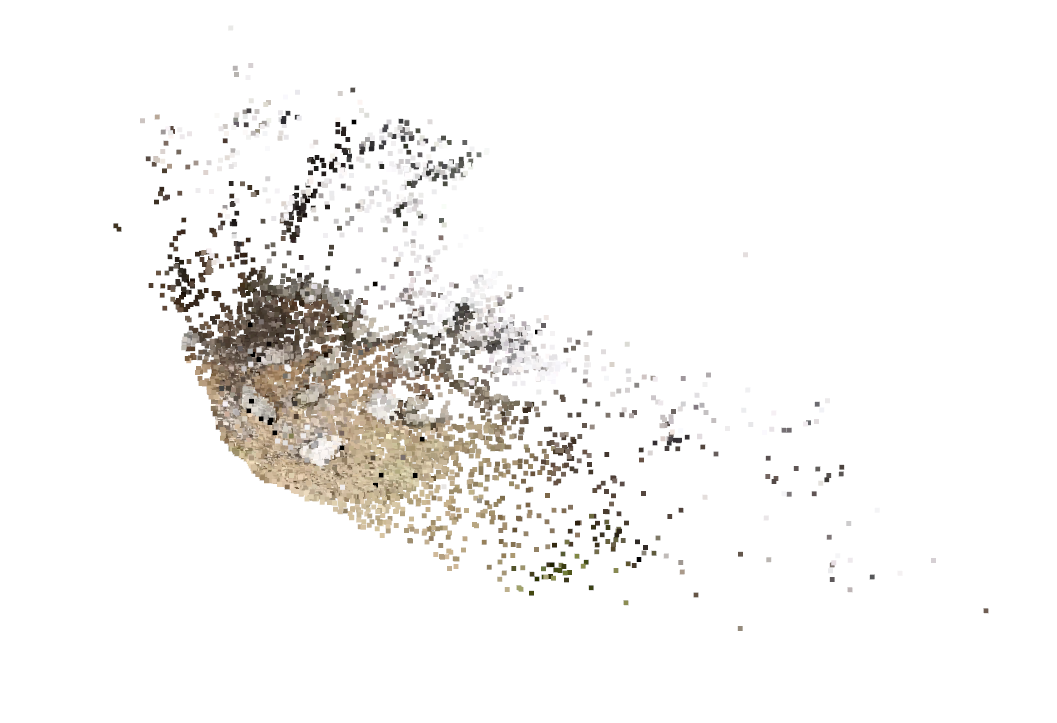
To rebuild signals or images from a small number of measurements, the sparse reconstruction algorithm is used. The original signal or image can be accurately recreated with fewer data points by taking advantage of the data's intrinsic sparsity. Applications where it would be prohibitive due to cost, time, or other factors to acquire complete data can benefit greatly from this.
Point cloud filter
Point cloud filtering techniques are utilized to enhance the quality of 3D data by removing noise, outliers, and unwanted points. The Open3D library is employed to apply radius-based filtering and statistical outlier removal methods, ensuring a cleaner and more accurate representation of the underlying surface. These filtering techniques not only contribute to the efficiency and robustness of the subsequent processing steps, but also enable more reliable analysis and interpretation of the 3D data. By incorporating advanced point cloud filtering methods into the project, the overall performance and accuracy of the 3D processing pipeline are significantly improved.
Possion reconstruction
Poisson reconstruction is employed as a key technique for reconstructing a smooth and continuous 3D surface from point cloud data. By leveraging the robustness and accuracy of Poisson reconstruction, complex shapes and sharp features can be effectively captured and represented. This approach involves modeling the surface as the zero-level set of a 3D scalar function, which is derived from an approximation of the object's indicator function. The Poisson equation is then solved using numerical methods to obtain the smooth scalar function, and the reconstructed surface is extracted as the zero-level set. The integration of Poisson reconstruction into the project greatly enhances the quality and fidelity of the generated 3D surfaces, providing a solid foundation for further analysis and processing of the 3D data.
laplacian
In order to improve the quality of the 3D geometry used in this project, Laplacian smoothing is applied to the mesh in order to shift the positions of the vertices. By redistributing the vertices and dampening the high-frequency noise, this method creates a more refined and aesthetically beautiful shape. The project uses the Laplacian smoothing technique to guarantee that the resulting 3D models are of a high enough quality to be used in subsequent processing, analysis, or visualisation steps. Laplacian smoothing's incorporation into the project's processing pipeline significantly boosts performance and resilience, leading to superior outcomes in 3D geometry processing.
User Interface
This project provides an interactive and user-friendly interface that enables users to easily input their point cloud data and obtain a reconstructed 3D surface in PLY format using Poisson surface reconstruction. By integrating Open3D and a suitable GUI library , the function streamlines the process of loading point cloud data, preprocessing, and performing Poisson reconstruction. The output PLY file, representing the reconstructed surface, can be conveniently saved for further analysis, visualization, or processing. This function simplifies the process of 3D surface reconstruction, making it accessible to users with varying levels of technical expertise and ultimately improving the overall user experience in working with point cloud data and surface reconstruction algorithms.